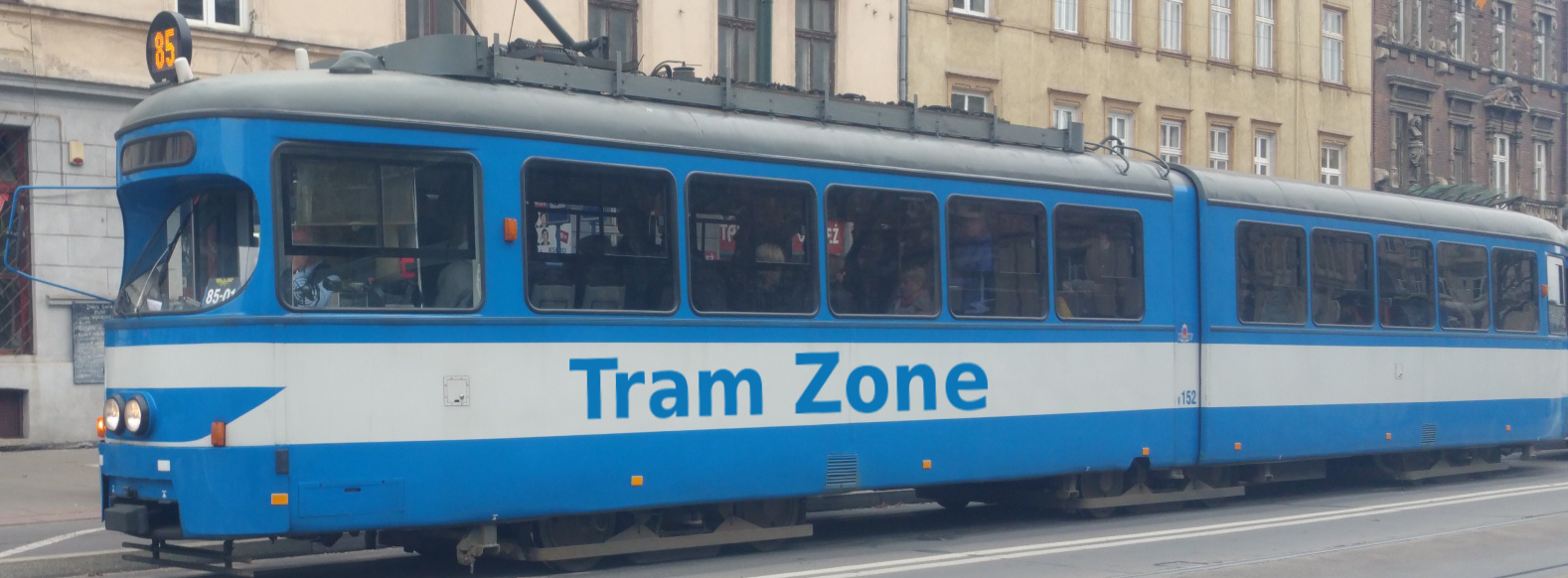
Tram systems in Plzeň
Plzeň is situated in western Bohemia at the confluence of the Mže, Radbuza, Úhlava and Úslava rivers. It is the capital and largest city of the Plzeň Region and the fourth-most populous city in Czechia.
The city was founded by King Wenceslaus II in 1295 and developed into an important commercial and administrative centre. Its historic core is centred on the large náměstí Republiky, which is dominated by Saint Bartholomew's Cathedral and its 102-metre tower.
Plzeň is internationally associated with brewing. The pale lager first produced at the city's Bürgerbrauerei in 1842 became known as Pilsner beer and is now represented by the Pilsner Urquell brewery. The city is also an important engineering centre and the home of the Škoda industrial group, which has manufactured locomotives, trams and other heavy-engineering products.
Plzeň hlavní nádraží, immediately east of the city centre, is the city's principal railway station. It is served by long-distance and regional trains towards Prague, Cheb, České Budějovice, Klatovy and destinations across the German border.
Urban public transport is operated by Plzeňské městské dopravní podniky (PMDP) and comprises trams, trolleybuses and conventional buses. Services are integrated with regional buses and trains through Integrovaná doprava Plzeňského kraje, the integrated public transport system of the Plzeň Region.
The tramway forms the principal high-capacity element of the urban network, linking the historic centre and main railway station with the large residential districts to the north, east and west, and with the university and employment areas at Borská pole.
Plzeň has a standard-gauge electric tram network operated by PMDP. Three cross-city lines, numbered 1, 2 and 4, operate over approximately 22 kilometres of infrastructure and converge in or immediately around the city centre.
Line 1 connects Bolevec in the north with Slovany in the southeast. Line 2 runs between Skvrňany in the west and Světovar in the east, while line 4 links Košutka with Bory, the West Bohemian University campus and the Univerzita terminus at Borská pole.
Although the system has only three regular lines, each serves a separate corridor through the outer city. The common central section provides access to náměstí Republiky, the main railway station and other principal interchange points.
Plzeň's rapid industrial growth during the nineteenth century created a need for a more effective urban transport system. Plans for an electric tramway were prepared by Czech electrical engineer and inventor František Křižík, whose company constructed the electrical equipment in cooperation with local manufacturers.
Services began on 29 June 1899. Unlike many early European systems, the Plzeň tramway was electrically operated and built to standard gauge from the outset.
The original network consisted of three predominantly single-track routes between Bory and Lochotín, Skvrňany and Nepomucká třída, and náměstí Republiky and Plynárna. A depot and generating station were established on the site of a former sugar factory in Cukrovarská.
The route towards Plynárna was extended in 1910 and again in 1929, eventually reaching Doudlevce. Route numbers were introduced in 1925, replacing the coloured identification previously used for the original lines.
Increasing traffic led to the progressive conversion of the network to double track. The route towards Nepomucká třída was doubled during the late 1920s, while extensions were constructed farther into Skvrňany and Slovany. Turning loops opened at Bory and Slovany in 1937, allowing the introduction of single-ended trams.
A second alignment was also constructed around the northern side of náměstí Republiky in 1929. Together with the existing southern tracks, this allowed trams to operate in both directions around the central square.
A new depot at Slovany entered use during the Second World War. Plzeň and its industrial facilities suffered substantial bombing damage during the conflict, but tram services were restored as the city recovered.
The Skvrňany route was converted to double track after the war. In 1949, the former tram corridor between Lochotín and Doudlevce was withdrawn and replaced by trolleybuses, although part of the abandoned infrastructure remained in use for access to the workshops in Cukrovarská until 1994.
Despite this closure, the tramway was retained as a central part of the city's public transport system. Modern Tatra T1 cars arrived during the 1950s, followed by Tatra T2 and T3 vehicles that progressively replaced the original two-axle fleet.
Construction of large housing estates from the late 1950s created new demand for tram services. The southeastern route reached Světovar in 1962, while a new alignment brought trams into the Skvrňany housing estate in 1973.
The network expanded northwards during the 1980s to serve the developing districts of Košutka and Bolevec. The Bolevec route initially opened only in part and was completed to its present terminus in 1990.
These projects established the three principal cross-city corridors that continue to define the modern network: Bolevec–Slovany, Skvrňany–Světovar and Košutka–Bory.
The Škoda engineering works in Plzeň returned to tram manufacturing during the 1990s. The partly low-floor Škoda 03T, also known as the Astra, entered service in its home city during the late 1990s and represented a significant change from the high-floor Tatra vehicles that had previously dominated the fleet.
PMDP subsequently introduced reconstructed Tatra trams with low-floor sections, VarioLF vehicles and modernised KT8D5 articulated cars. Fully low-floor Škoda 40T trams entered service from 2021, continuing the close association between the city's tramway and its local railway manufacturing industry.
For many years, the Bory terminus required passengers travelling to the West Bohemian University campus and the expanding Borská pole employment district to transfer to buses or trolleybuses.
A 1.39-kilometre extension of line 4 opened on 16 December 2019. The route continues from Borský park through a new transport interchange at Bory and the Technická stop to a turning loop at Univerzita.
The extension created a direct tram connection between northern Plzeň, the city centre, the university and the Borská pole commercial and industrial zone. It was the first substantial addition to the network since completion of the northern routes around three decades earlier.
The historic Slovany depot was comprehensively reconstructed while remaining operational. The project provided new storage and maintenance halls, modern workshops, an automatic washing facility and improved accommodation for staff.
The rebuilt depot was completed in 2023. Environmental measures included green roofs and the collection of rainwater for washing trams and maintaining landscaped areas.
Plzeň is preparing a new tramway to the Vinice and Sylván residential districts. Provision for a tram route was incorporated into the development of Vinice during the 1980s, but the district has continued to rely principally on buses.
The new double-track line will branch from the existing line 4 corridor beyond Zoologická zahrada and run for approximately 1.5 kilometres along the central reservation of Na Chmelnicích. It will terminate near Mikulovská and include four new stops. Parts of the line will have grassed track, while the surrounding street will be reconstructed with additional pedestrian, cycling, parking and landscaping facilities.
The branch is intended to be served by a new line 3 between Vinice and U Synagogy in the city centre. Longer-term operating plans envisage extending line 3 across the centre to supplement line 4 towards Bory.
Plzeň City Council approved the project and an application for European funding in March 2026. Construction is currently intended to begin in 2027 and must be completed by the middle of 2029 to meet the proposed funding timetable, although this remains dependent on the remaining approvals, funding and procurement. Further information is available from the City of Plzeň.
The former military barracks at Slovany are planned to be redeveloped as a major new urban district. Proposals envisage more than 3,000 homes together with offices, shops, public facilities and a central park, accommodating approximately 10,000 residents when development is complete.
Plzeň's transport planning provides for an extension of the existing Slovany tram corridor through the redevelopment area. The route could continue for approximately 4.5 kilometres from the present line near náměstí Milady Horákové towards Mezi Řekami, providing public transport for the new district as it is constructed.
The redevelopment and tramway remain at an earlier stage than the Vinice project. A detailed alignment, funding package, construction programme and opening date have not yet been confirmed. Further information about the proposed district is available from the City of Plzeň.