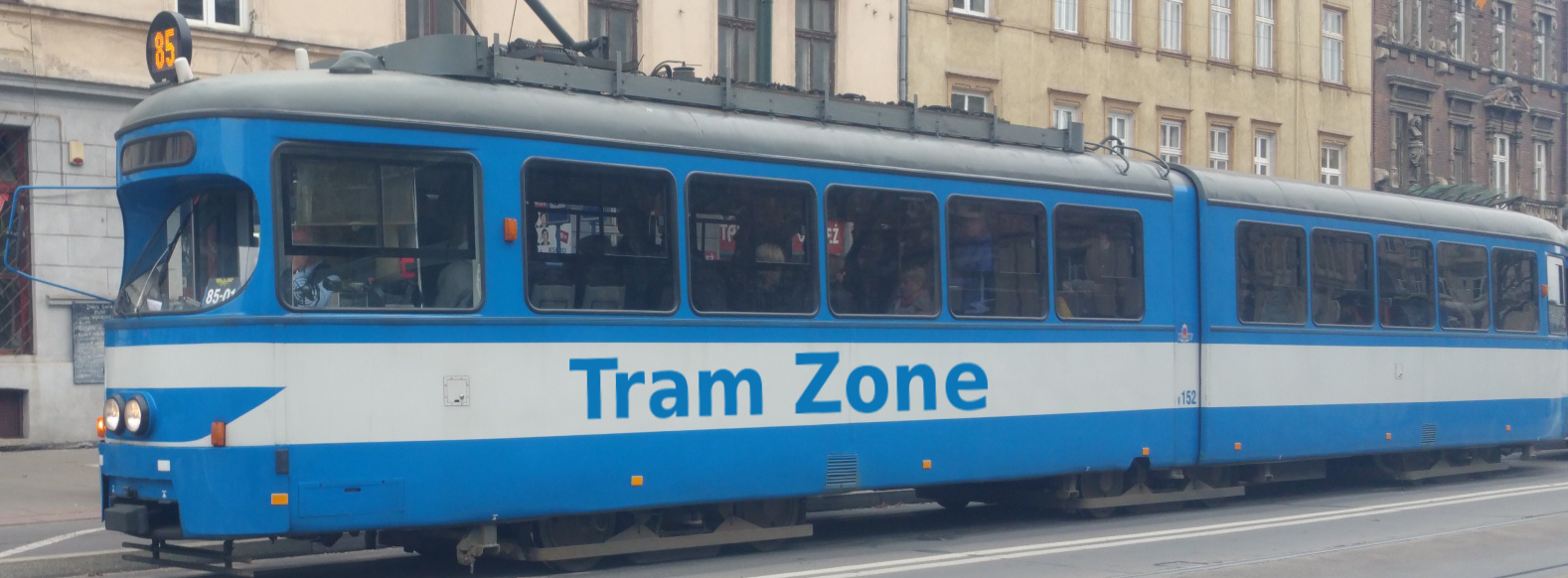
Tram systems in Vitebsk
Vitebsk is located in northeastern Belarus, close to the country's borders with Russia, Latvia and Lithuania. The city stands where the Vitba flows into the Western Dvina and is the administrative centre of the Vitebsk Region. With approximately 358,000 residents, it is the fourth-most populous city in Belarus.
Traditionally considered to have been founded in 974, Vitebsk is one of the country's oldest cities. It developed as an important trading centre on routes linking the Baltic and Black Sea regions and later became a significant industrial and cultural centre. The artist Marc Chagall was born in Vitebsk, while Kazimir Malevich and El Lissitzky were among the artists associated with the city's influential early twentieth-century art school. Vitebsk also hosts the annual Slavianski Bazaar arts festival.
Vitebsk railway station is located west of the historic centre and is served by regional and long-distance trains. The adjoining bus station provides regional and intercity coach services.
Urban public transport is provided by trams, trolleybuses and conventional buses. The tram and trolleybus networks are operated by the City Electric Transport branch of Vitebskoblavtotrans. Trolleybuses were introduced in 1978 and have subsequently assumed several corridors previously served by trams.
Vitebsk has a broad-gauge tram network comprising seven routes, numbered 1, 2, 3, 6, 7, 8 and 9. The network is approximately 36 kilometres long when measured as double track, and most of its infrastructure is separated from other road traffic.
The principal tram corridors connect the Maksima Gorkogo district in the southeast with the city centre, railway-station area, Titova district and the large residential areas along Moskovsky Prospekt. Other branches serve the Petrusya Brovki terminus in the southwest, the Marko industrial area northeast of the centre and the turning loop at Smolenskaya Square.
Most services are operated by high-floor Belkommunmash trams built in Belarus, together with a small number of older vehicles. Two fully low-floor BKM T811 trams entered the Vitebsk fleet in 2025, representing its first new trams for more than a decade.
The development of the Vitebsk tramway began after an agreement was signed on 4 February 1896 with French citizen Fernand Guillon, acting on behalf of Belgian financier Édouard Otlet. The concession covered the construction and operation of an electric tramway and its associated power station.
Electric tram services began on 30 June 1898, corresponding to 18 June under the calendar then used in the Russian Empire. Vitebsk became the first city in what is now Belarus to operate an electric tramway and one of the earliest cities in the Russian Empire to do so.
The original metre-gauge system was approximately 5.1 kilometres long and operated with 18 motor cars and 16 trailers. Its power station had already begun supplying electricity during 1897 and also provided power to a limited number of buildings in the city.
The tramway was nationalised in 1918. Services were disrupted during the revolutionary and civil-war period, but the system was restored and progressively developed during the 1920s.
Trams also played an industrial role in the city. Freight tracks connected factories with the railway network, and tram vehicles were used to carry bricks and other materials. During periods of conflict and disruption, tramcars were also adapted for emergency purposes, including the transport of wounded people.
A new traction substation opened in 1931, allowing the tramway to receive power from the regional electricity system. During the 1930s, the original metre-gauge network was converted to the 1,524-millimetre gauge subsequently used by Soviet tramways in Belarus.
Tram operation ceased on 11 July 1941 following the German occupation of Vitebsk. The city suffered extensive destruction during the Second World War, and much of the tramway's infrastructure, power supply and rolling stock was damaged or lost.
Reconstruction began after the city was retaken in 1944. Test operation resumed during August 1947, and regular passenger services returned on route 1 on 5 October 1947. The remaining pre-war routes were progressively restored, with all six operating again by the early 1950s.
The reconstructed network initially used repaired pre-war vehicles, supplemented by new Soviet-built KTM-1 trams and KTP-1 trailers. MTV-82 cars were subsequently introduced, followed by KTM-2 trams during the 1960s.
A period of substantial expansion began during the 1960s. A single-track extension to Zhurzhevo opened in 1960 and was doubled in 1963, while another extension reached the Polotsk Market area in December 1962.
Route 7 was introduced in October 1966, and the tramway was extended along Frunze Prospekt during 1967. New RVZ-6M trams began to replace older vehicles towards the end of the decade.
The network continued to grow during the 1970s. A new eastern route using Sadovaya Street opened in November 1973, followed in August 1974 by a line from Victory Square along Moskovsky Prospekt. By 1977, Vitebsk had approximately 61 kilometres of tram tracks, ten routes and 133 passenger cars.
Expansion was accompanied by the removal of tramways from several central streets. The line along Lenin Street closed in April 1972, while the former route between Victory Square, the city centre and Frunze Prospekt was abandoned in August 1983. Replacement links allowed services to operate around the central area rather than directly through it.
Trolleybus operation began on 1 September 1978, and the tram and trolleybus undertakings were combined the following year. Although trolleybuses subsequently replaced trams on some corridors, new tram infrastructure continued to be constructed.
A connecting line along Smolenskaya Street opened in December 1981. The network reached the television factory on Petrusya Brovki Street in December 1985, and a further extension across the Kimovsky Bridge towards Markovshchina opened on 8 May 1988. The closure of the old Blokhin Bridge temporarily severed one tram connection in 1988, but tram operation across the river was restored over a replacement bridge in 1994.
Vitebsk's tramway experienced financial difficulties during the 1990s, and the operating fleet declined from 145 cars at the beginning of 1997 to 108 early in 1998. Several new KTM-8 trams were nevertheless obtained during the decade, and a historic tram was restored for the system's centenary in 1998.
Fleet modernisation resumed with the delivery of Belarusian-built AKSM-60102 trams between 2005 and 2009, followed by AKSM-62103 vehicles. An original early tramcar was placed on display near the depot in 2008 as a monument to the system's history.
More recently, parts of the network have been rationalised. Route 4 was withdrawn in November 2018 and replaced by trolleybus route 13. Route 5 closed in July 2020 when tram tracks were removed from part of Gagarina Street. A new turning loop at Smolenskaya Square opened on 16 July 2021, creating a revised terminus for routes 1 and 3.
Two low-floor BKM T811 trams were presented to the city in May 2025. Their introduction marked the beginning of another stage of fleet renewal and improved accessibility for passengers unable to use the steps of the older high-floor cars. Further information is available from BKM Holding.
Tram infrastructure along Maksima Gorkogo Street is being reconstructed between the City Central Clinical Hospital and the outer turning loop. The corridor is used by several routes and provides the principal tram connection to the large residential districts southeast of the city centre.
The work includes renewal of the tram tracks and is being coordinated with other utility and road works in the area. Temporary closures have been required during 2026, with replacement transport and altered tram services introduced while individual sections are unavailable.
Once completed, the project should improve track condition, reliability and operating speeds on one of the most intensively served parts of the network. A definitive completion date for all tramway work has not been publicly confirmed.
Further reconstruction of Vitebsk's tram infrastructure is included in the Belarusian government's national Transport of Belarus 2026-2030 programme. Tram-track reconstruction in Vitebsk is identified as one of the significant urban transport projects to be undertaken during the programme period.
Detailed information about the sections to be renewed, the order in which work will take place and the overall funding allocated specifically to the tramway has not yet been published. The programme nevertheless provides a framework for continued investment beyond the current work on Maksima Gorkogo Street. Further information is available from the Ministry of Transport and Communications of Belarus.
The arrival of the first two low-floor BKM T811 trams in 2025 established a potential model for future fleet replacement. The new cars provide step-free boarding, air conditioning, passenger-information equipment and other facilities absent from much of the existing fleet.
Most Vitebsk services remain dependent on high-floor trams, including vehicles that have been in operation for several decades. Further orders would therefore allow the operator to improve accessibility while gradually replacing its oldest cars, although a complete funded fleet-replacement programme and delivery timetable have not yet been announced.
Various extensions have previously been suggested for expanding tram coverage into newer residential areas, particularly districts beyond the present southwestern and southeastern branches. These ideas have not developed into an approved construction programme, and recent public-transport expansion in several parts of Vitebsk has instead concentrated on trolleybus and electric-bus services.
The immediate future of the tramway is consequently centred on renewing its existing infrastructure and rolling stock rather than constructing new lines. Any former extension proposals should be treated as longer-term possibilities unless they are incorporated into a funded city or national transport programme.